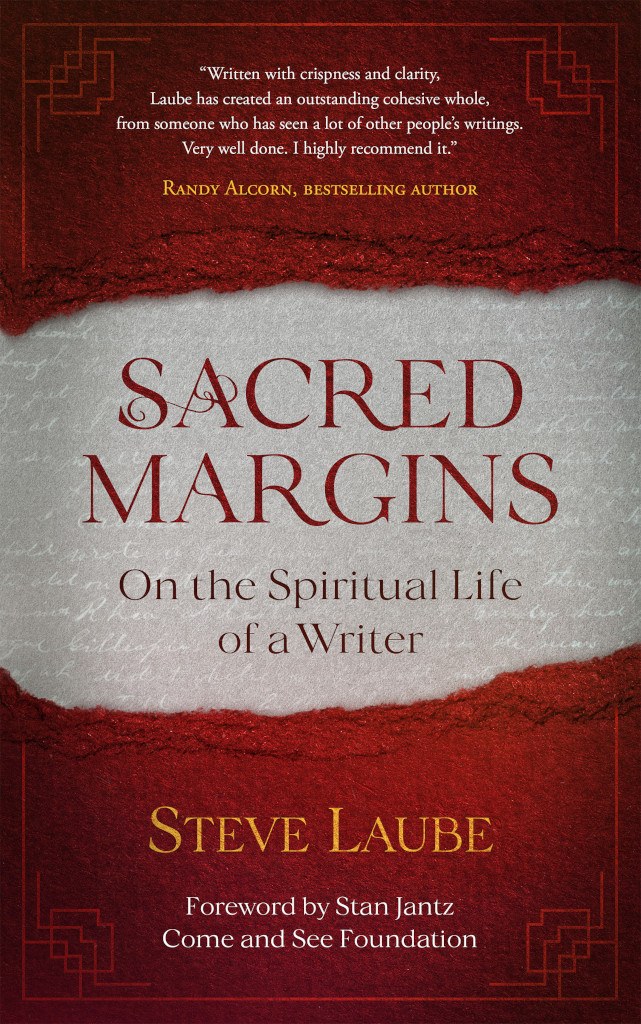
Sacred Margins On the Spiritual Life of a Writer
“A blank page has no margins.”
Buy the book Paperback, ebook, and audio, from the retailer you prefer
Watch the trailer
Quotations from the book
In the author’s own words, one passage from each part of the book.
-
Introduction
“Writers live in these spaces, shedding light on the margins so that the words themselves are guiding marks.”
-
Chapter 1
The Yearn to Write“The blank page is not truly empty; it is filled with possibility.”
-
Chapter 2
The Alchemy of Memory“Memory becomes an altar, a place where the pieces of our life – good and bad alike – are offered to the Lord and transformed by his mercies.”
-
Chapter 3
The Wonder of Imagination“God could have made a drab world of all gray and utilitarianism. Instead, he gave us a world full of color, music, seasons, and animals.”
-
Chapter 4
The Transparency of Broken Places“This act of creativity is a way of saying, ‘Here I am, Lord, broken but yours. Use even this.’”
-
Chapter 5
The Crucible of Lament“When we write our chapter of lament, we are led to our chapter of restoration.”
-
Chapter 6
The Carnage of Time“We, too, engage in a holy rebellion when we choose to write deeply, rather than quickly.”
-
Chapter 7
The Plight of Self-Doubt“We no longer write to prove our worth, but because we are loved and called.”
-
Chapter 8
The Gravity of Waiting“Though waiting is hard and often agonizing, it is not a waste. Every moment of patient trust is formative.”
-
Chapter 9
The Agony of Criticism“The ultimate judgment of our work lies with God.”
-
Chapter 10
The Peril of Success“Therefore, create with excellence but hold the results lightly.”
-
Chapter 11
The Darkness Can Be Pierced“The darkness may press in, but the darkness will not overcome the light.”
-
Chapter 12
Perseverance in the Sacred Craft“The goal of a writer is not publication at all costs; it is obedience to the one who calls.”
About the book
Sacred Margins is not a manual on plot, proposals, or platform. Steve Laube has spent more than four decades among books as a bookseller, editor, publisher, and literary agent, and here he turns from the business of writing to the soul of the person holding the pen. He treats writing as a vocation, received from God and offered back to him, and he follows that vocation through the places where it is tested.
The book is arranged in three parts. The first is a series of twelve chapters on the writing life. The second gathers twenty-one spiritual exercises for a writer whose fire has burned low. The third is a reading plan meant to last for years.
Part One
Sacred Margins
Twelve chapters on the interior life of a writer, from the first pull toward the blank page to the resolve to keep going.
The Yearn to Write
Why words press to get out, and what changes when writing is received as a calling and answered in obedience.
The Alchemy of Memory
Remembering as a sacred act, in which the past is redeemed and memory becomes an altar.
The Wonder of Imagination
Imagination traced to its root in the image of God, and defended against the notion that imagined means untrue.
The Transparency of Broken Places
The risk of setting weakness on the page, and what a reader receives when a writer goes first.
The Crucible of Lament
Sorrow carried into the presence of God, where faith and art are tested and refined.
The Carnage of Time
Chronos and kairos, the clock and the appointed moment, in the working life of a writer.
The Plight of Self-Doubt
The whisper of “I’m not good enough,” answered by Moses, Jeremiah, and the sufficiency of God.
The Gravity of Waiting
What God forms in a writer during delay, in a culture arranged to remove every wait.
The Agony of Criticism
Criticism as the unavoidable cost of meaningful work, and how to receive it without being ruled by it.
The Peril of Success
Success redefined as faithfulness, apart from rankings, awards, and applause.
The Darkness Can Be Pierced
Writing as a war of witness, with prayer as the first line of defense.
Perseverance in the Sacred Craft
Holding fast through revision, rejection, and obscurity, with obedience as the measure of a writer’s life.
Part Two
Rekindle Your Inner Fire
Twenty-one spiritual exercises, written to stir the coals of a writing life and let the embers catch the breath of God. They are meant to be read slowly, and they do not replace the regular study of Scripture. Each one follows the same six movements.
Rest
Quiet the mind of distraction, not to empty it but to fill it with Christ.
Read
Receive a passage composed of Scripture gathered from across the Bible.
Reflect
Savor the words of the text, because they are the words of God.
Respond
Pray with praise, confession, repentance, and supplication.
Ruminate
Consider what other writers across the centuries have said on the same theme.
Record
Write down your thoughts, beginning with a title of your own.
Part Three
A Lifetime Reading Plan
On a shelf in his living room Steve keeps the books that have shaped his spiritual growth. He calls them his “Punctuation Marks,” because some were a comma, some an exclamation point, and some a full stop. The final part of the book shares that shelf as a list of more than fifty titles, to be read slowly over the course of years. Two dozen of them appear below.
Where to begin
Short, accessible books the plan marks as good starting points.
- The Knowledge of the Holy A. W. Tozer
- Life Together Dietrich Bonhoeffer
- The Practice of the Presence of God Brother Lawrence
- The Screwtape Letters C. S. Lewis
- Sit, Walk, Stand Watchman Nee
- Intimacy with the Almighty Charles Swindoll
- Waiting on God Andrew Murray
- Repentance M. Basilea Schlink
- Making All Things New Henri Nouwen
- Your God Is Too Small J. B. Phillips
- The Green Letters Miles J. Stanford
- A Shepherd Looks at Psalm 23 W. Phillip Keller
For writers
Books on creativity, the arts, and how a Christian moves within that world.
- Adorning the Dark Andrew Peterson
- The Writing Life Annie Dillard
- 100 Prayers for Writers Bob Hostetler
- The Storied Life Jared C. Wilson
- Breath for the Bones Luci Shaw
- Walking on Water Madeleine L’Engle
- On Writing (and Writers) C. S. Lewis
- The Soul Tells a Story Vinita Hampton Wright
- Scribbling in the Sand Michael Card
- The Beauty Chasers Timothy D. Willard
- Art and Faith: A Theology of Making Makoto Fujimura
- The Christian Imagination edited by Leland Ryken
What readers have said
“The writing must come from an inner wellspring of spiritual vitality based on an understanding of and a deep connection to God Himself.”
“Written with crispness and clarity, Laube has created an outstanding cohesive whole, from someone who has seen a lot of other people’s writings. Very well done. I highly recommend it.”
“I will return to this book time and again in the years to come. It reflects a breadth that I admire.”
“Every chapter echoes the truths I have long held to be the reason why I write. I wish I’d had this resource when my writing journey began. Many fellow word artists will find their true compass on these pages.”
“Writing can be a lonely and self-absorbing journey. Here is guidance from a fellow pilgrim who has gathered and distilled wisdom from Scripture and from other travelers. Steve Laube presents comfort, encouragement, and inspiration in a little book that is absolutely a blessing. Strongly recommended.”
“This book, and its accompanying spiritual exercises, are a gift to those who accept the challenge of communicating God’s truth.”
“This book guides wordsmiths closer to the Word.”
“This book is a beautiful reminder that writing is not just a job, but a calling.”
“He reminds us that the work God calls us to do is inseparable from the work He is doing in us.”

About the author
Steve Laube is a literary agent and president of The Steve Laube Agency. He has worked in the book industry for more than four decades, first as a bookstore manager whose store was named National Store of the Year by CBA, and then with Bethany House Publishers, where he was named Editor of the Year by AWSA.
As an agent he and his agency have represented nearly 3,000 new books, and ACFW has twice named him Agent of the Year. He was inducted into the Grand Canyon University Hall of Fame by its College of Theology. He is the publisher of Enclave Publishing and president emeritus of The Christian Writers Institute.
His other books include The Christian Writers Market Guide, Write Your First Novel (with Gilbert Morris), and The Chosen Presents: A Blended Harmony of the Gospels (with Dallas and Amanda Jenkins). His office is in Phoenix, Arizona.
“And now, go, write it before them on a tablet and inscribe it in a book, that it may be for the time to come as a witness forever.”
“The world will be different tomorrow because of the words you write today.”
Soli Deo Gloria