SomedayToday I’ll write a novel.
Write YourFirst Novel
A beloved novelist and a veteran editor and agent teach the brand-new writer the art and craft of fiction, one foundational principle at a time, with exercises to practice each of them.
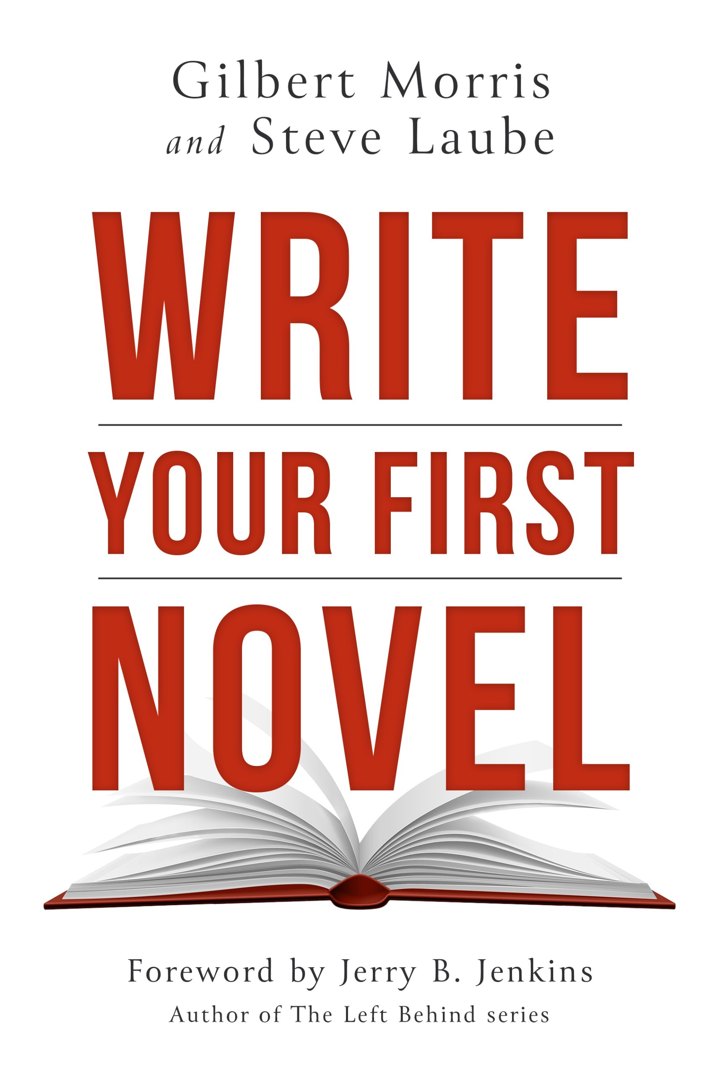
“Gilbert Morris was a giant as a novelist, and Steve Laube is one of the brightest lights as an agent in the Christian market.”
It began with an editor’s red pen
Steve Laube was a brand-new editor at Bethany House Publishers, with no formal education in how fiction is written and a novel waiting to be edited. One of the first books he read to teach himself the craft was by the best-selling novelist Gilbert Morris.
A few years later he was handed the editorial work on a Gilbert Morris novel, Through a Glass Darkly. In Steve’s words, their friendship was “forged in the fire of editorial scribblings,” and Gilbert dedicated the finished book to him.
After Gilbert passed away, Steve looked for a way to continue his friend’s legacy. This book pairs the best of Gilbert’s teaching on fiction with chapters of Steve’s own, shaped by thirty years of teaching at writers conferences and acquiring books as an editor and literary agent. It makes no claim to groundbreaking secrets. It offers the building blocks upon which all good fiction rests, so that by the end a new writer has everything needed to write a first novel.
“To Steve Laube, who made this one possible.”
the start of a friendship
Try a lesson before you buy
Chapter 5 teaches the difference between telling readers what a character feels and letting them discover it. Both examples below are Steve’s own, taken from that chapter. Pick up the red pen and see what changes.
Avoid -ly adverbs
“You are telling the reader what the character is feeling,” Steve said sternly.
Steve frowned as his eyes scanned the page. His red pen flicked once, twice, three times with a slash. He looked up at the eager student across the desk and said to her, “You can do better than this.”
From the chapter: “The word ‘sternly’ is no longer necessary in this example.”
Resist the urge to explain
Steve’s eyes grew wider for a moment.
Steve’s eyes widened.
From the chapter: “Trust your reader to fill in the blanks.”
Examples by Steve Laube, from Chapter 5, “What Is ‘Show Don’t Tell’?”
Watch the video
Two voices, seventeen chapters
The book moves through a novel in the order a writer meets its problems, and the two authors trade chapters along the way. Choose a name to follow one voice through the book.
Front matter
- ForewordJerry B. Jenkinsxiii
- PrefaceLaubexv
Introduction
- How to Use This BookMorris3
- What Is Good Fiction?Laube7
Section One: Plot
- 1 Plot ConstructionMorris13
- 2 The Magic of PlottingLaube25
- 3 Common Plot MistakesLaube35
Section Two: Beginning
- 4 In the BeginningLaube45
Section Three: Show Don’t Tell
- 5 What Is “Show Don’t Tell”?Laube55
- 6 The Heart of FictionMorris59
Section Four: Point of View
- 7 Point of ViewMorris85
Section Five: Characters
- 8 Character Development: Appearance and SpeechMorris101
- 9 Fiction Is PeopleLaube115
- 10 Character Development: Behavior and PsychologyMorris123
Section Six: Dialogue
- 11 DialogueMorris143
- 12 Dialogue Is a Two-Way StreetLaube157
Section Seven: Setting
- 13 Setting: ElementsMorris167
- 14 Setting: UsesMorris179
Section Eight: The End
- 15 Leaving the Reader SatisfiedLaube199
Section Nine: What’s Next?
- 16 A Philosophy of WritingMorris205
- 17 Final ThoughtsLaube213
Appendix
- What Makes Christian Fiction Christian?Laube217
Sets of exercises follow the chapters on plot, show don’t tell, point of view, characters, dialogue, and setting. The book closes with a list of nearly twenty books for further study.
Lines you will want to underline
“What plot boils down to is a person with a problem.”
“Trust your reader to fill in the blanks.”
“Every new writer must finish that first novel, no matter how hard or how bad it is.”
“Writing must be rewritten.”
What working novelists say
“You’ll be itching to use this practical tool before you finish the first chapter.”
“Few people know more about writing and publishing than Steve Laube, which is why I love having him in my ear in my career. It’s also why you need to read this book if you want to be a better writer.”
“What a dream team! Gilbert Morris, the consummate novelist, paired with Steve Laube, a multi-talented publishing pro, have created the perfect resource for an aspiring fiction writer. You’ll learn the who-what-when-where-why of storytelling from the very best in the business. Every chapter is a gem!”
“An invaluable resource. Practical, instructional, and inspirational, with enough detail and examples to teach without overwhelming. Write Your First Novel contains everything you need to do just that. Read this book and do what it says—you’re in great hands. (Where was this book when I needed it 30 years ago?)”
“Write Your First Novel is like a writers conference in a book.”
“Every novelist needs a copy of Write Your First Novel to not only learn the craft of creating a dynamic novel but also to reread the wisdom of two icons in the publishing industry.”
“Every now and then a writing book comes along where I say, ‘I seriously wish this had been around when I started my author journey.’ Write Your First Novel is one of those books. Buy it. Now. Your future self will be extremely grateful.”
Also endorsed by James Scott Bell, Joseph Bentz, Nadine Brandes, Lynette Eason, Sara Ella, Tricia Goyer, Sharon Hinck, Steven James, Ronie Kendig, Kyle Mann, and Kara Swanson.
Meet the authors
Gilbert Morris
1929–2016
Gilbert Morris was the author of more than 250 novels in his career, including the forty-volume best-selling House of Winslow series for Bethany House. With nearly 7 million copies of his novels sold worldwide, he is considered by many to be “the grandfather of Christian historical fiction.”
He won the Christy Award in 2001 for his novel Edge of Honor and was a beloved teacher and mentor to hundreds of writers. Once a pastor and English professor, he earned his Ph.D. at the University of Arkansas.

Steve Laube
Literary agent, editor, and publisher
Steve Laube, a literary agent and president of The Steve Laube Agency, has been in the book industry for over forty years, first as a bookstore manager where his store was awarded the National Store of the Year by the Christian Bookseller Association. He then spent over a decade with Bethany House Publishers and was Editorial Director of Nonfiction.
He was honored as Editor of the Year by the Advanced Writers and Speakers Association and has twice been named Agent of the Year by the American Christian Writers Association. He is the publisher at Enclave Publishing and president emeritus of The Christian Writers Institute.
The world will be different tomorrow by the words you write today. Steve Laube, from the Preface